Don't have a Momentum Pass yet? Ask your manager or team lead to sponsor your team's expedition — they cover the trail, your team takes the journey. Or invite them to explore how Momentum Quest works.
Why does work feel different?
It's rarely the work itself. It's the hundred small things around it — how decisions get made, how people communicate, how the team responds when things get hard.
Most of it is invisible. No one designed it. It just… formed.
The work isn't always the problem. Sometimes it's the way we work.
So what is ZenWorkspace?
Every team develops a pattern.
Over time, your team settles into its own way of working —
how you communicatehandle pressuremake decisionssupport each other
These patterns quietly shape how work feels every day.
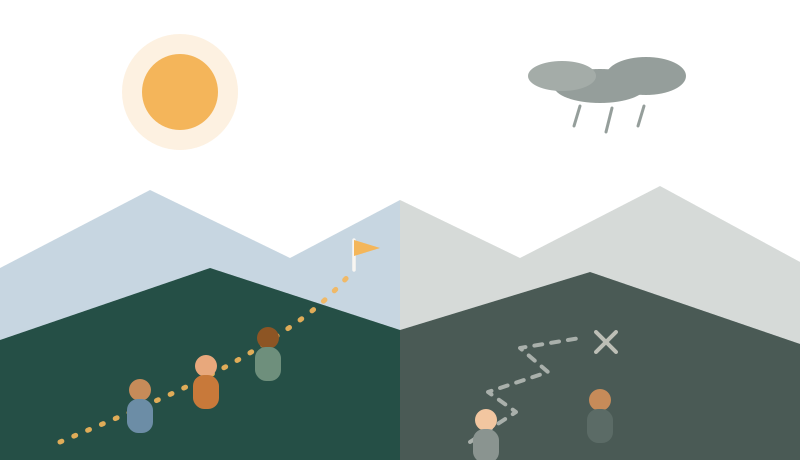
Some create momentum
Work flows. Energy builds.
vs
Others create friction
Effort drains away, unseen.
Some of your patterns create momentum. Others quietly drain it — and most teams have never seen their own pattern clearly.
We took the invisible patterns teams fall into, gave each one a name and a terrain of its own, and turned discovering your team's into an expedition — not an assessment, not a personality label. Something your team actually wants to go find.
Why we call it an expedition
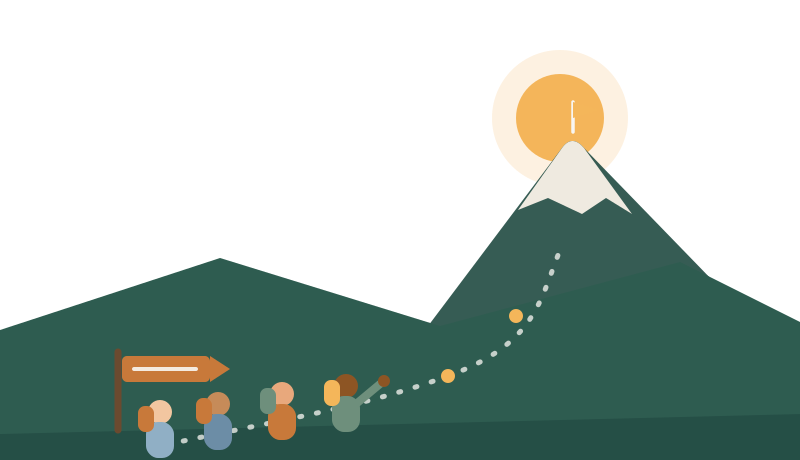
Join a team, and you begin an expedition — whether you realize it or not.
Every team is trying to reach the same destination: a place where the work flows and people do their best work together. That feeling has a name — momentum — and it's why every team here sets out on a Momentum Quest.
The surprising part? Getting there isn't mostly about talent, motivation, or working harder. It's about the conditions around the work — how you communicate, how decisions get made, how trust is built, and how challenges are handled.
Those invisible patterns shape your team's momentum every single day. Momentum Quest is how we finally make it visible — so you can measure it, track it over time, and intentionally build more of it.
Not your regular workshop — an expedition your team actually moves through, together.
Meet the Momentum Quest
This is where it gets exciting.
Your team's pattern doesn't sit in a report gathering dust. It becomes the map for an adventure your team takes together.
Your whole team sets out from the same trailhead.
You explore how you actually work.
You spot the patterns you've been living inside for months.
And you discover things about your team you've never had words for — until now.
What it is
A personalized virtual team experience — about an hour, no facilitator, no offsite. Built entirely from your team's own responses, so no two teams ever take the same journey.
Not a surveyNot a workshopAn expedition your team sets out on — together
Starting at $495 per team · per season · 5–15 people. Have a Momentum Pass? Begin your expedition.
What's a Momentum Practice?
Think about every team you've ever worked on.
Every one had little unwritten rules that made it feel the way it felt.
"We check in with teammates who seem unusually quiet."
"We hand off work with enough context so the next person isn't left guessing."
"We ask for help before our workload becomes overwhelming."
"We celebrate progress, not just finished projects."
Nobody wrote these down. They just became how the team works.
Those weren't policies. They became habits. Momentum Practices work the same way — small, team-designed workflows that reduce friction and make work feel better over time.
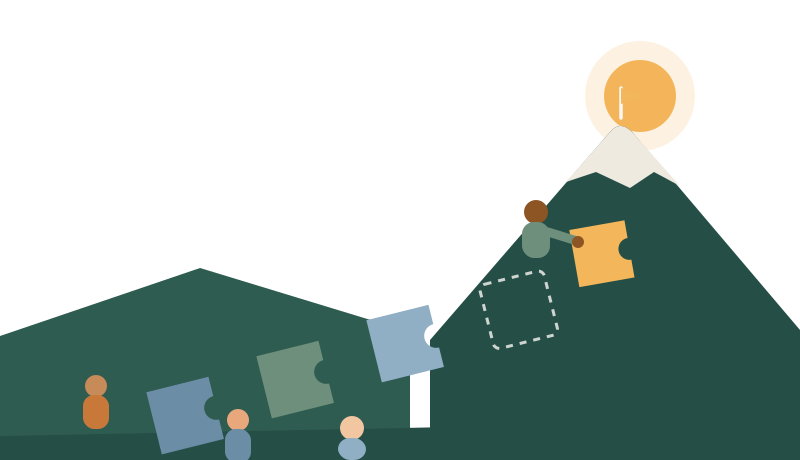
Your team designs one during every Momentum Quest. Then you practice it until it becomes part of how your team naturally works.
One small habit your team agrees to practice together. That's how work starts to feel different.
The Team Patterns
The patterns have names. Which one sounds like your team?
Some teams give everything and forget to recover. Some deliver alone and win alone. Some love each other too much to say the hard thing. Each with its own name and terrain — and your team is one of them.
Your team walks away with one new way of working and a clear picture of the support that would help. Not prescribed. Not imported. Designed by your team — which is exactly why it works.
Every voice counts.
Everyone talks about improving teams. Few actually ask the team how work feels.
The people closest to the work usually have the clearest sense of what would make it better — and because every Momentum Scan is anonymous, the quietest voice on the team carries exactly as much weight as the loudest.
Your team's pattern isn't one person's opinion. It's what all of you create together.
The other half of the picture
Patterns are the terrain. Stages are the journey.
Your Team Pattern describes how your team works today. Your Stage describes where you are on the expedition — and every pattern crosses the same four stages:
Discovering
The trailhead
Noticing the patterns that shape how we work.
Building
The climb
Adding conditions that help work flow.
Aligning
The ridge
Strong foundations forming. Closing the gap.
Momentum
High Camp
All conditions strong. Protect what works.
High Camp is rare on purpose. The Quest reveals both halves of your team's answer — your pattern and your stage.
The team changes itself. Leadership doesn't run the Quest, sit in on it, or see anyone's answers. That's why we call them sponsors — they don't take part in the expedition. They make it possible.
The team
Designs the change
Your team explores its own pattern and chooses its own Momentum Practice. The insight comes from the people closest to the work.
The sponsor
Receives the Expedition Map
A leadership view of where the team is and the support conditions that would help most — so leaders can remove obstacles, not assign fixes.
Where the team isThe support that would helpNever anyone's individual answers
Teams create the momentum. Leaders create the conditions where it grows.
By a team, we mean a group of people working toward a common goal. The Quest takes about an hour, and it works best for teams of 5 to 15 — big enough for a real pattern to surface, small enough for every voice to count.
About an hour, together
Teams of 5–15
One shared goal
A project or product squad
Cross-functional teammates shipping toward a shared launch, sprint, or deadline — where how you work together decides whether you hit it.
A department or function
A sales, marketing, operations, or engineering team under one leader, looking to work with less friction and more momentum.
A sports team or coaching staff
Athletes and coaches aligning before or during a season — turning individual talent into a group that moves as one.
Smaller or larger team? It still works — 5 to 15 is simply where the Quest shines.
Your team already has a pattern.
Every team has one. The question isn't whether your team has a pattern.
The question is...
What is it creating?
Momentum?orOpportunities for something better?
Built so everyone can be honest.
Covered by your passYour team lead sponsors the season
100% anonymousNo individual data. Ever.
Teams of 5–15The size that works best
6 minutesQuick Momentum Scan, real insights
You're not out there alone
Every expedition has a Ranger.
Your team doesn't set out unguided. The Ranger walks the whole trail with you — setting the ground rules, keeping the conversation open, and making sure the quieter voices get invited in. Nobody gets put on the spot. Nobody has to volunteer something they'd rather not.
And your answers stay yours. Responses are anonymous by design — they only ever surface as a team pattern, never traced back to a person, and never shown to leadership. The whole experience was built so people can be honest without it costing them anything.
One Quest changes a conversation. Seasons change a team.
A team's way of working took years to form. One season starts the shift — each season after is where it takes hold. Every season, your team returns to the trail: sees what's changed, and takes the next step together.
Season 1 · Now
Find your route
Discover your pattern and choose your first Momentum Practice.
Season 2
Walk it
Return, see what's changed against your baseline, and keep climbing.
Season 3
Adjust
New terrain, new insights — refine how your team works.
Season 4
Keep building
Momentum compounds. Better habits become how your team simply works.
…and the expedition continues.
Teams don't become high-performing because they work harder. They become high-performing because they learn how to work better together.