
For teams adopting AI
Turn AI adoption into collective productivity.
AI makes individuals faster. Momentum Quest helps the whole team work better with AI and with each other, so time saved isn’t lost to rework, unclear ownership or learning alone.
Your AI strategy needs a team strategy
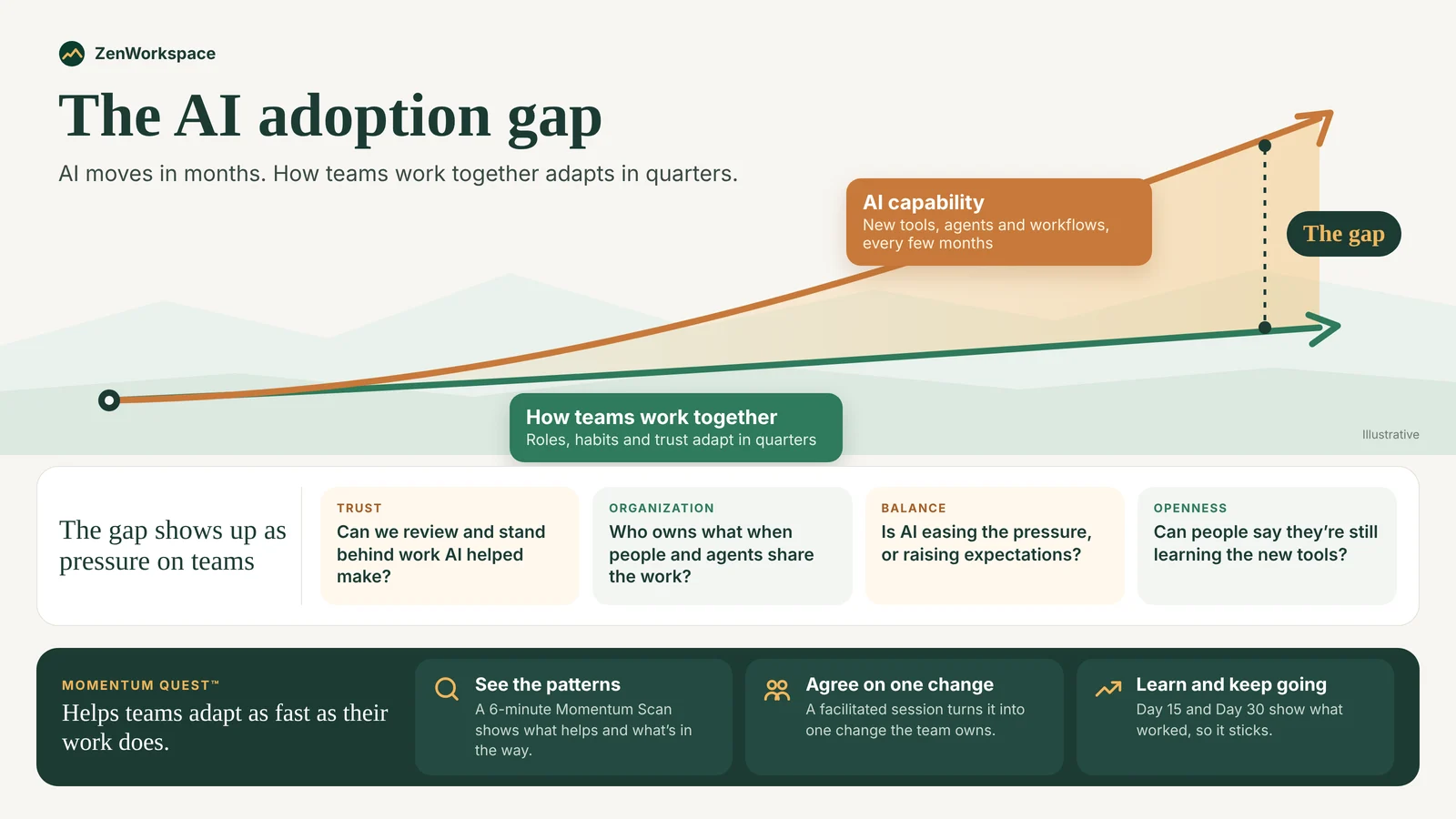
Tools change in months. How teams work together takes longer.
Without shared team practices, AI gains leak into rework, unclear ownership and people learning alone. A team AI strategy closes that gap one change at a time.
66%
of employees rely on AI output without evaluating its accuracy.
KPMG and University of Melbourne, Trust in AI, 2025
56%
have made mistakes in their work because of AI.
KPMG and University of Melbourne, Trust in AI, 2025
74%
of regular AI users now ask a chatbot what they used to ask a colleague.
MyIQ global survey of 22,000+ employees, 2026
AI adoption is a team effectiveness challenge
Faster individuals don’t automatically make faster teams.
One AI-assisted customer draft
13×
more team time than the dashboard shows
What adoption dashboards count
5 min
Counted as time saved
What the team lives through
0 min
15 min
30 min
45 min
60 min
65 minutes across 3 people for a draft counted as 5.
Hypothetical example, not measured Momentum Quest results.
What teams can improve
Five places AI adoption gains or loses value.
Quality of work
Gets in the way: Unchecked AI output, low-quality drafts.
A team might track: Drafts returned for correction.
Collective productivity
Gets in the way: One person’s time saving becomes others’ rework.
A team might track: Hours of avoidable rework.
Human-AI collaboration
Gets in the way: Unclear ownership between people and agents.
A team might track: Tasks with no clear owner.
Resource efficiency
Gets in the way: The same problem solved again and again with AI.
A team might track: AI cost per completed task, from your own data.
Collective learning
Gets in the way: People learn alone with AI, not from each other.
A team might track: Recurring questions answered once and shared.
Outcomes teams choose to pursue, not guaranteed results.
Efficiency benefits
Less rework and less waste, for one team and then many.
A Quest turns one team’s agreement into a habit. When several teams take part, those habits add up to savings the organization can see in its own data.
One team
After a successful Quest
The team agrees how it works with AI, and with each other.
- Fewer drafts returned for correction
- Less senior time spent fixing AI output
- A clear owner for work people and agents share
- Fewer repeated questions and duplicate attempts
Many teams
Across the organization
What works in one team is shared, not reinvented.
- Proven agreements shared through the Trail Library
- Prompts, checks and context reused across teams
- Fewer overlapping tools bought for the same job
- Leaders see where teams need support, without watching individuals
Engineering teams
At the heart of the change
Coding assistants and agents are changing how engineers build, review and learn.
- Agreed rules for reviewing AI-generated code
- Clear ownership of agent-written pull requests
- Shared context files and prompts, not everyone starting over
- Fewer failed agent runs and re-runs
- Juniors still learn from seniors, not only from the assistant
Lower AI token costs
Every retry, re-prompt and duplicate agent run costs tokens.
When a team agrees how it uses AI, fewer tasks get run twice and good prompts get reused. A team can track AI cost per completed task from its own usage data. We never see your prompts or tokens.
Same question, five people, five separate runs
Run
Run
Run
Run
Run
Solved once, shared, reused by the team
Run
Reuse
Reuse
Reuse
Reuse
“AI’s primary role in software development is that of an amplifier. It magnifies the strengths of high-performing organizations and the dysfunctions of struggling ones.”
DORA, Google Cloud
2025 State of AI-assisted Software Development, nearly 5,000 technology professionals
Benefits teams choose to pursue and measure with their own data, not guaranteed results.
How it works with AI
The same 30-day Quest, focused on AI adoption.
When your sponsor chooses “Adopting AI or automation” at setup, the Momentum Scan adds 7 statements about how AI is affecting the team. The team then picks one meaningful change, and its sponsor sees the result at Day 30.
“It is clear who is responsible for work involving AI on our team.”
“We have shared practices for verifying AI-assisted work before relying on it.”
“We continue to learn from one another as AI becomes part of our work.”
What teams changed
The assistant made each person faster. The Quest helped each team get faster together.
Trail log · No. 01
Engineering · AI adoption
The Keystone Team
6 engineers · coding agents for 4 months
REACHED
Day 30
28h
18h
Weekly senior review time
Friction
AI sped up code, but reviews landed on two senior engineers.
Drain
Fairness · How fair work feels
Chose
A shared approach to owning and reviewing AI-assisted code.
Also
AI spend per merged change, indexed: 100 → 85
Trail log · No. 02
Customer Success · AI adoption
The Lighthouse Team
8 teammates · AI assistant for 3 months
REACHED
Day 30
7
3
Drafts sent back each week
Friction
AI drafts looked polished, but errors created rework and eroded confidence.
Drain
Trust · How reliable teamwork feels
Chose
A shared check for AI-assisted customer messages.
Also
Weekly senior correction time: 6h → 3h
Trail log · No. 03
Team integration · Organizational change
The Bridge Builders
Two teams combined · 4 new teammates
REACHED
Day 30
4h
90m
Time waiting for a useful answer
Friction
Help was slow, and always came from the same few people.
Drain
Connection · How connected we feel
Chose
A peer support practice that widened who people turn to.
Also
Answers reused on other accounts: 0 → 3
ZenWorkspace provided the structure. The team created the solution.
Sample teams · illustrative 30-day scenarios, not measured customer results
Different teams. Different realities. Their own solutions.
There is no universal agreement for better teamwork. Momentum Quest helps each team discover what is getting in its way, choose one meaningful change and learn from putting it into practice. The solution belongs to the team. The ability to keep improving stays with them.
Works inside your AI policies
From AI policy to everyday team practice.
Your AI governance sets the guardrails. Each team agrees how it will work inside them.
The policy says
Human oversight is required.
The team decides
Who checks which outputs, and when?
The policy says
Humans remain accountable.
The team decides
Who owns work that people and agents share?
The policy says
AI should improve productivity.
The team decides
How do we stop time saved becoming others’ rework?
Not AI training, and not a governance or monitoring tool. We don’t track prompts or tokens; any usage data stays yours.